
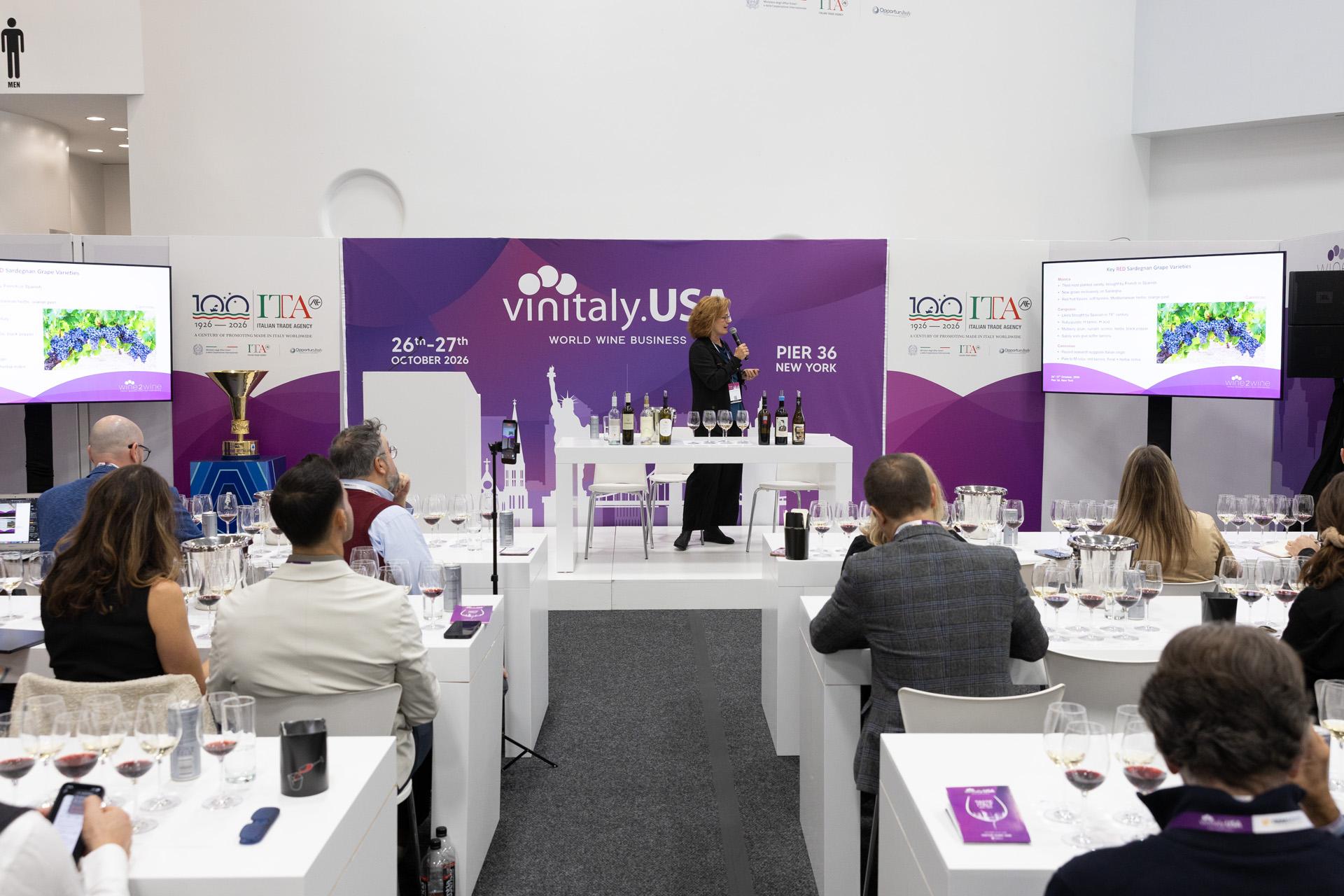
wine2wine is the business conference Veronafiere runs alongside Vinitaly, and its thirteenth edition took place in New York at the end of October under the Vinitaly.USA banner — two days of panels and masterclasses about selling Italian wine in America. One key takeaway had nothing to do with Italy. Francis Creighton, who leads the Wine & Spirits Wholesalers of America, the trade body for the middle tier of the US distribution system, described the structural problem plainly: “The total linear feet of shelf space is not expanding; it’s going down … the number of brands keeps going up.” Much of what followed over the two days reads as a response to that sentence, whether or not the speaker knew it.
It is tempting to assume that a shrinking shelf means everyone loses a little. That is not what is happening. The contraction is concentrated at the value end, especially among varietally labeled bottles priced between roughly $8 and $15 that could come from almost anywhere. Those wines offer no clear reason for shoppers to choose them over the bottle next to them. They are also competing with ready-to-drink products, which now account for 12.4% of total alcohol dollars by making drinking easier, not necessarily by tasting better.
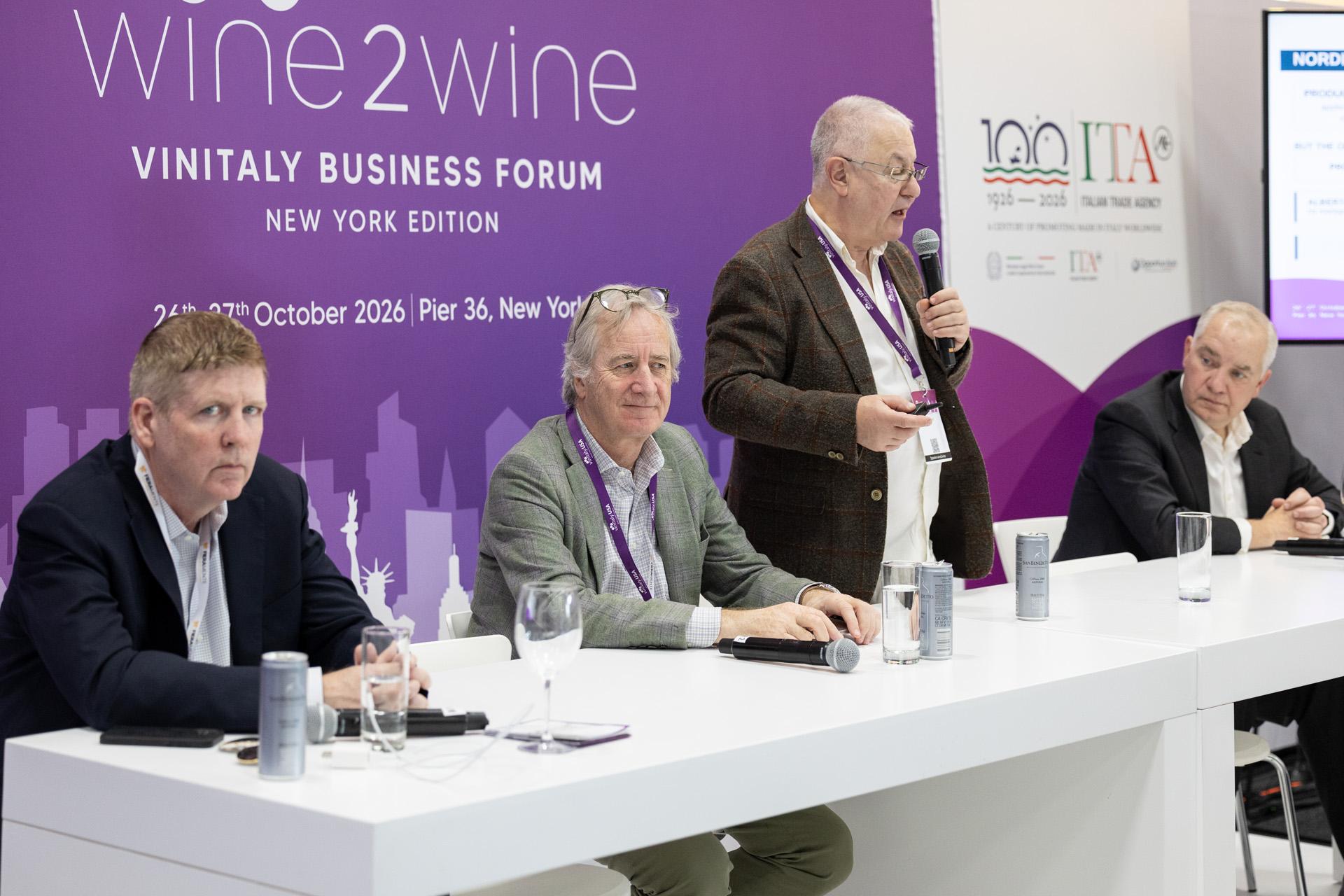

Italian wine is over-indexing in American retail right now, and the Texas market panel was blunt about why. It is not that Italian wine has gotten better faster than everyone else’s. It is that Italian wine communicates place even at fifteen dollars, because the label is forced to. Tian Lewis, who buys statewide for the Texas retailer Twin Liquors, described what survives on a value shelf: Italian wine “communicates a sense of place and specificity, even if it’s still offering a value perspective.” A Vermentino di Gallura — a white grown on granite in one corner of northern Sardinia and the island’s only DOCG — cannot pretend to be from nowhere. The collapse is happening to wines that can.
That is the commercial case for specificity, and it is stronger than the romantic argument the Italian trade usually reaches for. Specificity is not just a heritage flourish. It is the one position on the shelf a competitor cannot simply copy.
The forum supplied the evidence from four unrelated rooms. Bartholomew Broadbent, whose importing company represents 45 family wineries and lists 450 individual wines, put the concentration flatly: “We sell 450 SKUs. 80% of the business is with probably six SKUs.” He added that several of the most prestigious names in that book are carried because they improve the book rather than because they sell. Sarah Heller MW, who teaches at the Vinitaly International Academy, spent two hours arguing that concentration isn’t quality, and that a wine with more weight and length may simply serve a different commercial purpose. Her stated brief was to be “clear-eyed about what is good quality or great quality at a lower price point, and what is actually not better quality.” Stephanie Johnson DipWSET and Jack Liggett, both of whom sell these wines to American restaurant guests, demonstrated the floor-level version: Schiava and Schioppettino — a pale red from Alto Adige and a peppery one from Friuli — do not sell on the grape name, which almost nobody can pronounce, but on the fact that both nearly vanished and came back. “You sort of have this really cool story of resurrection from the dead,” as Liggett put it — “especially with younger guests, they really appreciate those kind of stories.” And the masterclass on metodo classico — Italian sparkling wines made with the same second-fermentation-in-bottle method as Champagne — produced numbers that complicate the easy premiumization story: Franciacorta at 18.9 million bottle equivalents in 2025, down 1.0%, while Alta Langa passed two million, up 11.5%. The flagship is flat. The specific, small, hard-to-copy thing is growing.



This is a trap for producers, and the forum didn’t name it well. Specificity is expensive. Pergola training is labor-intensive, Schiava is prone to mildew, and the money is not there. A grower in Alto Adige told Johnson: “It’s almost like a public service that we’re making this wine still, because we’re not making any money on it.” Heller made the same point from the opposite direction, on the orthodoxy of ever-lower yields: it “is not economically sustainable, and it’s not necessarily resulting in better quality.” Distinctiveness and margin are not automatically aligned. A producer who hears “be more specific” and responds by dropping yields on a variety nobody is asking for has moved further from the shelf, not closer to it.
The answer is not only in the vineyard. It is in whether the wine’s specificity is clear to the person making the purchase. A wine can be genuinely rooted in a place, but if it cannot explain that place in a sentence, it is commercially just a wine from nowhere with higher production costs.
Where to Take This Next
Nobody puts a number on the premium that specificity earns, or on how long it holds. Attendees are better placed to test that than anyone on the stage was, because the answer sits in their own category data: if Italian wine is over-indexing now because the value tier is collapsing, what happens when the contraction reaches fifteen to twenty-five dollars, where most Italian DOC wine actually lives? It is also a ready-made session for a future forum — one built around retailers and category managers rather than producers.
By Mike Wangbickler, DipWSET, CWE — Wangbickler Consulting & Education


